


 Sep 17, 2026
In oil palm cultivation, Potassium (K) serves as the primary driver for Fresh Fruit Bunch (FFB) weight and quality. Oil palms absorb Potassium in massive quantities—often exceeding their Nitrogen intake. Consequently, Potassium deficiency poses an immediate threat to plantation productivity and overall revenue.
Recognizing early symptoms and executing rapid corrective measures is critical to preventing long-term yield losses.
1. Dangerous Impacts of Potassium Deficiency on Oil Palms
The consequences of Potassium deficiency extend beyond leaf appearance, directly hurting economic yields:
-
Reduced Average Bunch Weight (ABW): Fruits remain undersized with thin mesocarp layers and poor oil synthesis.
-
Flower Abortion and Premature Fruit Drop: Female inflorescences abort before developing into harvestable bunches, or produce poorly filled, "empty" fruit sets.
-
Increased Vulnerability to Drought and Disease: Potassium regulates leaf stomatal closure. Deficient trees wilt rapidly during dry spells and become highly susceptible to foliar diseases like Curvularia.
2. Visual Symptoms of Potassium Deficiency in the Field
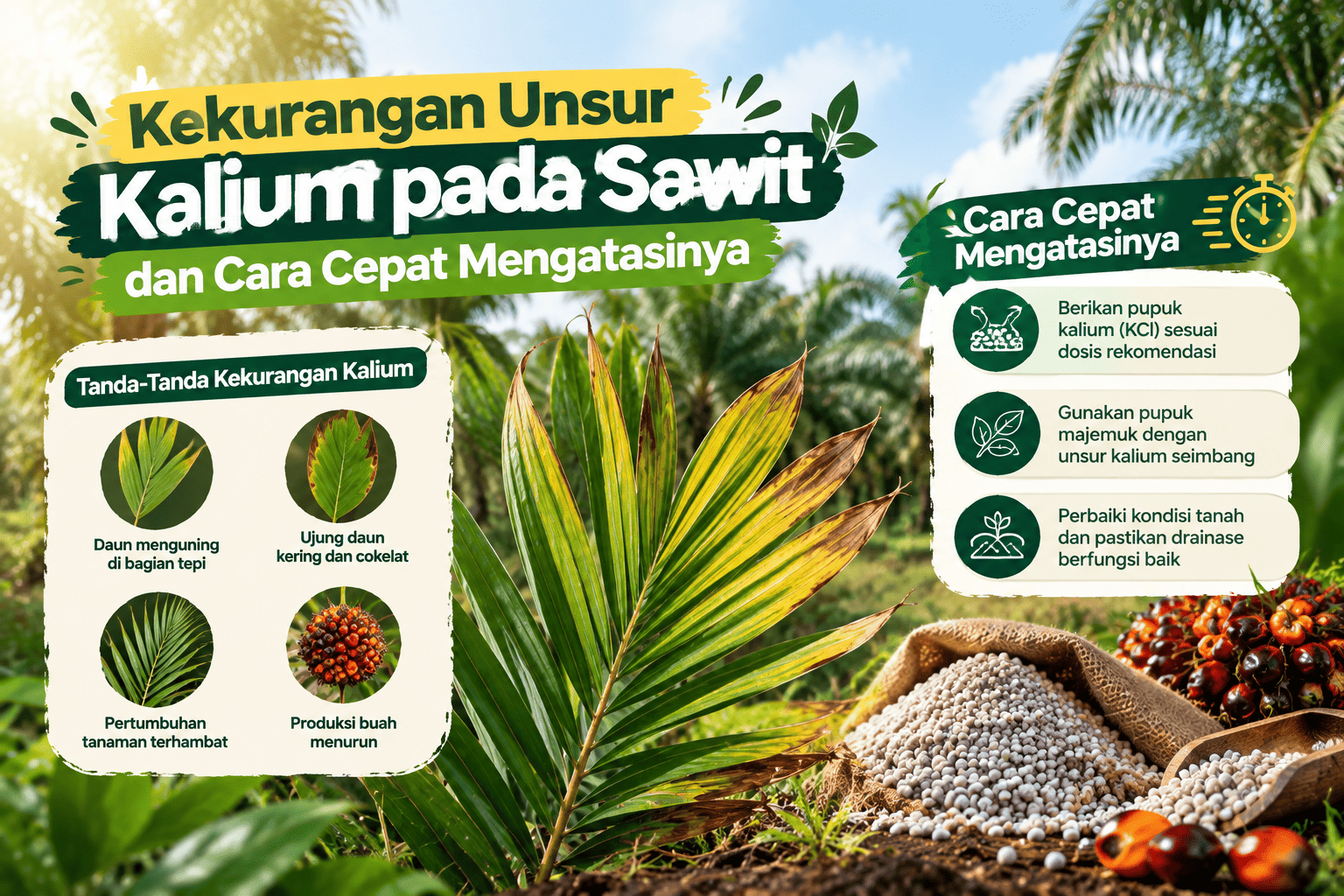
Potassium deficiency displays distinct visual indicators, primarily on older fronds:
-
Confluent Orange Spotting (COS): Translucent yellow-to-orange spots appear on older leaflets. Over time, these spots enlarge, coalesce, and cover entire leaflets.
-
Peat Yellows / Leaf Necrosis: Under severe conditions (common on peat soils), leaflets turn golden yellow, dry out from the tips and margins, and eventually die (necrosis).
3. Rapid Corrective Measures for Potassium Deficiency
When Potassium deficiency symptoms are identified, take the following rapid corrective actions:
-
Apply Fast-Release MOP / KCl (Muriate of Potash):
Immediately apply MOP ($K_2O \approx 60\%$) at corrective rates. For mature palms exhibiting moderate-to-severe deficiency, increase dosages to 2.5 – 3.5 kg/tree/year, split across 2–3 rounds.
-
Integrate Empty Fruit Bunches (EFB):
Apply EFB mulch at 200–250 kg/tree around weeded circles or inter-rows. EFB is a rich source of readily soluble organic Potassium that also improves soil moisture retention for faster nutrient uptake.
-
Maintain Magnesium (Mg) Balance:
Ensure heavy Potassium applications are balanced with adequate Kieserite/Dolomite. Over-applying Potassium without Magnesium can induce secondary Mg deficiency due to nutrient antagonism.
-
Foliar Application (Emergency Remedy for Young Palms):
For nursery stock or immature palms (TBM), spraying high-potassium foliar formulations provides rapid absorption through leaf stomata.
Conclusion
Potassium deficiency is a high-risk issue that requires swift intervention. By identifying early orange spotting symptoms, applying corrective MOP/KCl dosages, and leveraging organic inputs like EFB, plantations can quickly restore soil nutrient balance and safeguard FFB yields.